-
 IELTS Topic: ENVIRONMENT
Reading 2
Korea composts its way to sustainability
Original source: The New Yorker

Today, South Korea recycles ninety-five per cent of its food waste, but twenty-five years ago almost nothing was recycled. In the nineteen-nineties, following the country’s rapid industrialization and the movement of its people from rural areas to the cities, the trash dumps at the cities’ edges overflowed.
Poor families lived near the dumps; many of them picked through the garbage for plastics and metals to sell. Food scraps, an incidental petri dish for disease, made the dumps foul, sickening the garbage pickers.
“We had people lying down in the road in front of the garbage trucks to prevent more being brought to the landfills,” Kim Mi-Hwa, the head of the Korea Zero Waste Movement Network told me. “The government saw that it had to do something.”
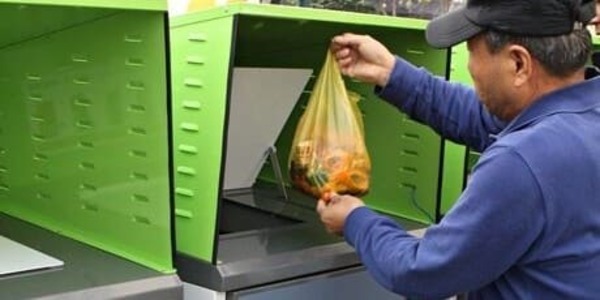
Seoul residents buy biodegradable bags for their food waste. The bags are put into bins located in the carparks of apartment blocks.
Source: inno4sd.net
South Korea now recycles 95% of its food waste
In 1995, South Korea replaced its flat tax for waste disposal with a new system. Recycling materials were picked up free of charge, but for all other trash the city imposed a fee, which was calculated by measuring the size and number of bags. By 2006, it was illegal to send food waste to landfills and dumps; citizens were required to separate it out.
These measures have led to a decrease in food waste, per person, of about three-quarters of a pound a day—the weight of a Big Mac and fries.
Residents of Seoul buy designated biodegradable bags for their food scraps, which are disposed of in automated bins, usually situated in an apartment building’s parking area. The bins weigh and charge per kilogram of organic waste.
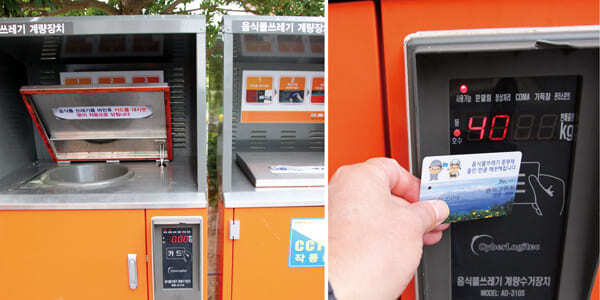
The automated bins weigh and charge per kilogram of food waste. For an average family this costs $6/month.
Source: Kim Gyong Ho/ Jeju Weekly
At the Energy Zero House, a model apartment complex in Seoul, a slim woman wearing dark clothes demonstrated how the “smart” composting bin worked. The bin resembled an industrial washer-dryer with a cheerful teal top, and had instructions for use in both Korean and English. She waved a small card, which looked like my grocery-store points card, in front of a scanner. The lid opened in a slow, smooth fashion. In went the waste and was weighed. Then the lid lowered.
Nearby was a separate container for used cooking oil. A tidy latticed structure covered the area, like a bus stop. For a Seoul family, the cost of food-scrap recycling averages around six dollars a month.
The food waste … becomes compost, animal feed or biofuel
The thirteen thousand tons of food waste produced daily in South Korea now become one of three things: compost (thirty per cent), animal feed (sixty per cent), or biofuel (ten per cent).