-
 IELTS Topic: TRANSPORT
Reading 3
Bus rapid transit systems work so well
Original source: The Guardian, The Guardian

Originally devised by Jaime Lerner – mayor of the Brazil’s Curitiba city – in the oil-shock year of 1974, a bus rapid transit (BRT) network is all about the art of doing more with less.
Its performance lies in recognising three facts: that a surprisingly large percentage of traffic congestion in cities is caused by the slow movement of buses; that most of the delay comes from buses loitering at stops during the boarding phase; and that swift boarding, in turn, is hamstrung by the need of each rider to pay one by one, as they board.
Lerner’s solution in Curitiba was to lift the buses up and out of the ordinary flow of the streets, segregating them on dedicated high-speed lanes and freeing up road space for other traffic.
The problems with boarding were solved by asking passengers to pay for trips before the bus even arrived, on entering specially designed, fully enclosed above-ground stations, which have since become iconic of the city.
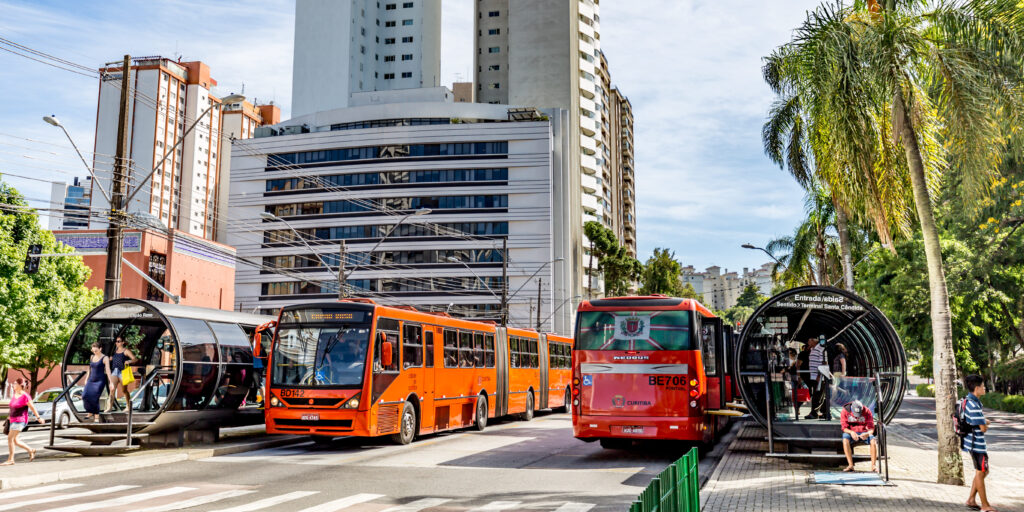
Curibita’s rapid transit system segregates buses into dedicated high-speed lanes. Passengers board them from fully-enclosed bus stations.
Source: Adam Smith/Shutterstock
All of this proved not only much quicker and easier to implement than any underground transit system, but – particularly appealing to a cash-strapped administration – vastly cheaper as well.
Curitiba-style BRT showed that a relatively low-cost, bus-based infrastructure could move masses of people through a city with the speed and capacity of a much more expensive metro system, while maintaining a flexibility no metro can ever muster.