-
 IELTS Topic: TRANSPORT
Reading 1
Integrating road and rail: everyone wins.
Original source: The Conversation, Victorian Government,
InTeck Freight & Logistics Inc

“Without trucks, Australia stops,” is a familiar refrain. And, for general freight, it’s true for most countries. Much of the reason that road freight volumes have exploded is due to major road upgrades, such as highways with dual carriageways, climbing lanes and town bypasses.
By contrast, rail movements, except for bulk commodities such as minerals like coal and agricultural products such as grain, has stagnated. The reason? One important one is that most roads are free to use. They are built and maintained with tax moneys. However, although road taxes are often built into fuel sales, they don’t recoup the cost of maintaining them or building new ones.
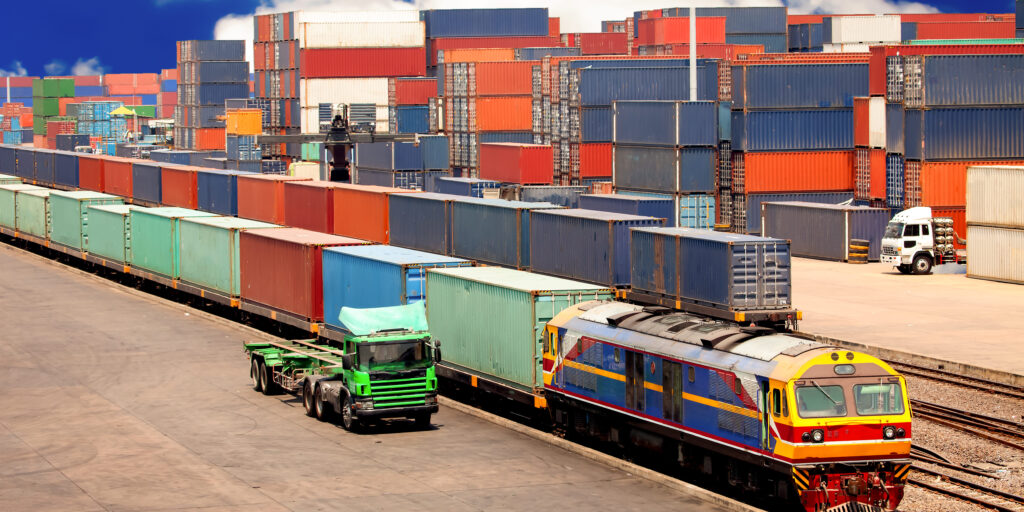
‘Intermodal transport’ uses shipping containers that can be stacked on both ships and trains as well as easily loaded onto trucks.
Source: nattanan726/ Shutterstock
The same is not as true of the railroads. As most people do not use long-distance trains, rail infrastructure attracts less public funds; it is seen as more of an industry benefit rather than a community benefit.
Long distance rail … uses a third of the diesel consumed by interstate trucks
So governments traditionally over-invest in roads and under-invest in rails. Yet long distance rail for general freight uses one third of the diesel consumed by interstate trucks. In fact, in Australia, non-urban transport costs by rail are 10% of the cost by road. After all, a single freight train can replace several hundred trucks.
In some countries, trucking companies have woken up to the benefits of this cost differential. They use a more innovative method called intermodal transport that use special standardised boxes, or shipping containers, that can be stacked on both ships and trains as well as easily loaded onto trucks.
For shorter distance, the convenient and flexible schedules of single trucks have their own cost benefits
In this system, trucks pick up pre-packed containers and take them to a rail hub to be loaded onto trains. At the destination city, often a thousand kilometres away, other trucks picks up the containers from the destination rail hub and deliver them to customers.
For shorter distances, the convenient and much more flexible schedules of single trucks have their own cost benefits that often outweigh the savings of rail.
Nevertheless, for very high volume, high frequency routs in cities, intermodal solutions can be great too.
Thus the Victorian and Australian Governments are investing millions to take trucks off inner city roads by building a new on-dock rail to transport shipping containers between the Port of Melbourne and rail hubs on the outskirts of the city. “The new Port Rail Shuttle Project will help cut the number of trucks on suburban roads by up to 100,000 each year,” says the country’s Transport Minister, Michael McCormack.
It will be so much more efficient for the truckers too. They will not have to spent all those hours crawling through congested streets and lining up behind one another at the port gate. Instead, they can drive straight into the rail hub and have their loads immediately lifted off.
Everyone wins.